Talos was a long-range high-altitude cruise missile designed to give the fleet stand-off protection against enemy aircraft and the ability to attack distant surface targets. It could attack aircraft, missiles, ships, radar installations and other shore facilities with either conventional or nuclear warheads. Talos had an effective range of about 100 miles and could engage targets from 50 feet to 80,000 feet altitude.
Talos was the U.S. Navy's first surface-to-air and surface-to-surface guided missile. It was a development of the Bumblebee program during World War II, along with the other "Ts", Tarter and Terrier. Damage inflicted by Japanese Kamikaze aircraft and German guided air to surface missiles and glide bombs during World War II brought light to the need for more effective fleet air defense. The three "Ts" were the first fleet missile defenses against the rapidly developing aircraft threat.
Talos was to be the first antiaircraft missile deployed to the fleet, but because of the complexity of the Talos system, the missile wasn't actually deployed until after the Tarter and Terrier systems were deployed. Originally intended for deployment in 1949, actual deployment wasn't until 1959.
The Talos missile relied upon guidance information from the firing ship. This limited the number of missiles a single ship could control at the same time. The guidance system transmitted a signal to direct the desired flight path. The missile followed this guidance signal to the target. A significant advantage of the beam riding control method was that the missile did not end up in a long, circuitous, fuel consuming tail chase as it approached the target. Instead the missile was guided to an altitude where it operated efficiently, and it was then flown to a predicted intercept point ahead of the target. This gave the missile a very long effective range. The ship illuminated the target with a high intensity signal from guidance radars and the missile homed in on the signal reflected from the target - this is called "semi-active homing." In the final phase of the intercept the missile dove on the target from above.
Talos was a very effective weapon system, but it occupied a huge amount of shipboard space and required a great deal of maintenance. Each missile had to be tested every 30 days. In addition, the Talos system could track only six targets, and engage only two of these at a time. This made it vulnerable to saturation attacks by large numbers of aircraft. The last version of Talos was introduced in the late 1960s. This anti-radiation missile carried additional electronics that allowed it to actively home on transmitting radars.
Eventually Terrier was developed into the Navy's Standard missile, and Talos was retired from the fleet by 1979. The missiles continued to be used as land launched supersonic targets in the Vandal program. For this use the missile was modified to allow it to fly in a surface-skimming cruise mode in addition to the normal high altitude mode. The Vandal targets contributed to the development of advanced Standard missiles. They were very challenging targets that were difficult to shoot down.
Missile description
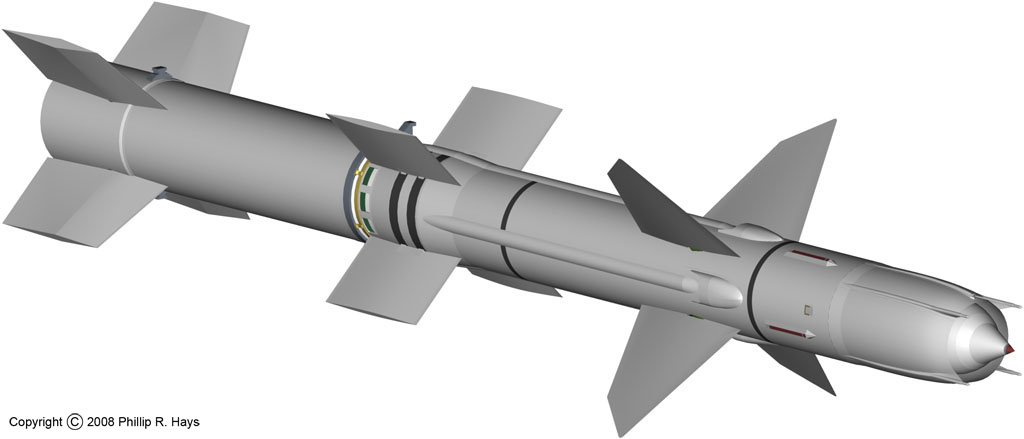
The Talos launch configuration consisted of a wing guided ramjet propulsion missile and a solid propellant booster. The missile airframe was a long hollow tube that formed the ramjet engine. At the forward end the warhead innerbody was bolted to the airframe on four struts. The innerbody was an aerodynamic ogive shape that functioned as the compressing element for the ramjet engine. A cowling fit around the warhead to form the compression chamber. A pitot tube and homing antennas were attached to the front of the cowling. Four moveable wings controlled the direction of the missile, and four fixed fins at the rear provided stability.
Aft of the warhead a cylindrical electronics compartment wrapped around the central tube. Behind this was a mechanical section containing air turbines, electrical generators and hydraulic pumps. These were located between the wing sockets. Hydraulic actuators located in this section provided wing motion for steering. Aft of the mechanical compartment the fuel tank wrapped around the ramjet tube. In early versions the tank carried enough fuel to give the missile a range of about 60 miles. Later versions had a larger fuel tank giving a range of 100 to 120 miles.
Behind the fuel tank the internal tube of the engine expanded to the tailpipe with the nozzle at the rear end. Inside the ramjet tube a perforated flame holder baffle kept the explosion from the burning fuel at the rear of the missile. A combustor ring sprayed fuel into the combustion chamber aft of the flame holder. Around the engine tube were a few small compartments where telemetry equipment could be installed for test shots. The RIM-8H anti-radiation missile also carried electronics in these compartments.
At the tail end of the missile were sockets for the four non-moveable fins and a flange for mounting the missile to the booster. Between the fin positions were several openings that allowed air to flow through the ramjet while it was still attached to the booster during the boost phase. These were necessary for operation of the air turbines and to "prime" the ramjet for operation when the booster separated. The guidance and telemetry antennas were located at the aft end of the missile.
Electronics and control package
Power for the control hydraulics was generated by air turbines that were driven by air compressed by the motion of the missile through the atmosphere. Some of the high pressure air from the ramjet intake flowed through the turbines and then vented to the outside.
Most of the electronics were located in modules fitted into compartments just forward of the wings, wrapping around the central ram jet tube. Early versions had vacuum tube circuits, using tubes designed for operation under high G forces. The tube circuits were bulky and the number of functions that could be crammed into the electronics space was limited. These were replaced with transistorized circuitry in the 1960s, followed by integrated circuits in the 1970s. Each new generation of electronics reduced the volume and weight of the circuitry necessary to control the missile, and made room for new and improved features. In the late 1960s a new anti-radiation electronics package was developed to allow the missile to actively home on enemy radars.
A socket in the side of the missile carried an Arming Plug that completed the connections in the missile control and warhead firing circuits. The missile would not function without the appropriate Arming Plug. This plug was removed and a test umbilical was installed in the socket during missile testing. Missiles carrying a conventional high explosive warhead used a white Arming Plug. Nuclear equipped missiles used a purple Arming Plug. The two plugs were not electrically interchangeable. While in the Area 2 ready service or Area 3 storage magazines conventional warhead missiles carried an ordinary white Arming Plug and nuclear armed missiles had a green Safing Plug installed in the socket.
Contact and proximity fuses
The missile contained two fusing systems to detonate the conventional high explosive warhead. On the tip of the warhead nose cone was a contact fuse that detonated the warhead if the missile made physical contact with the target. This was mostly a formality, because the 3400 pound missile colliding with the target at a relative closing rate of mach 2.5 to 3 possessed enough kinetic energy to destroy nearly any target. Add to this the flammable magnesium alloy airframe and jet fuel, and the result was a huge explosion. During a test exercise off the California coast the USS Oklahoma City fired a surface-to-surface shot without a warhead and caused such extensive damage that the target ship (a decommissioned DE) eventually broke into two parts! Most of the Okie Boat's surface-to-air test shots against Firebee drones resulted in skin-to-skin contact.
The missile carried four proximity fuse radar antennas along the sides of the fuselage just aft of the cowl on the surface of the electronics compartment. These antennas transmitted a conical waveform forward of the missile along the line of flight. If the target passed into this cone and reflected the signal back to the antennas the warhead was detonated.
Continuous rod warhead
When the explosive detonated the expanding gasses pushed the shell of rods outward, with each rod-to-rod connection bending to maintain a continuous ring of metal
out to a diameter of about 200 feet. Beyond this distance the ring broke and one or more "strings" of rods continued to move outward.
A common static test of this warhead was to support it vertically at the center of a circular area surrounded by a chain-link fence or a wall of aluminum plates.
When the warhead was detonated the expanding rod sliced through the entire circumference of the fence about half way between the top and bottom.
By repeating this test with different diameter fence circles it was possible to determine the effective range of the expanding rod.
When detonated in flight, because of the combination of forward motion of the missile and outward motion caused by the explosion, the expanding ring cut through a conical path in the air. This conical trajectory was identical to the cone projected by the proximity fuse antennas. Consequently, the expanding rod had 100% probability of hitting any target that triggered the proximity fuse at a range of less than 100 feet. Because of the lightweight construction of aircraft the expanding rod would slice the target into two or more parts.
W30 warhead
Talos could also carry a W30 nuclear warhead with a yield of about 0.5 kiloton. The purpose of this warhead was to allow engagement of large numbers of enemy bombers at a distance with a single missile. The flash of the explosion would blind pilots looking in the direction of the explosion, the electromagnetic pulse would damage aircraft electronics, and the blast would destroy aircraft up to a half mile of the detonation. The yield was low so a high altitude air burst would not damage ships on the surface below. The nuclear warhead could also be used against surface targets, either ships or shore facilities.
The fissile material for this weapon was Oralloy, uranium (U235). Much of the energy of the warhead came from a tritium boost of the uranium fission explosion. Tritium has a relatively short half-life of 12.3 years (half of the tritium will decay in about twelve years). Consequently, warheads had to be returned to nuclear weapons service facilities regularly to have the tritium reservoirs refilled. A warhead with a freshly filled reservoir could have a yield greater than 0.5 kiloton, while an older reservoir might give a yield as low as 0.3 to 0.2 kiloton.
Ramjet sustainer
The missile airframe was basically a long hollow tube with a warhead ogive at the front. Air flowing into the cowling around the warhead was compressed and heated. Jet fuel was injected into the air stream and ignited aft of the flame holder baffle. The expanding gasses of the burning air-fuel mixture propelled the missile forward. Ramjets are very efficient engines. This allowed Talos to achieve a very long operating range with a relatively small fuel load.
The missile accelerated to Mach 2.7 within 10 seconds after launching. An interesting characteristic of a ramjet is the faster it goes, the faster it goes. The higher the speed the more air is ingested and compressed. This causes more fuel to flow, increasing the burn rate, producing greater thrust, and making the missile go even faster. If allowed to continue the missile would accelerate to very high speeds where air friction would overheat the airframe and the missile would burn up. The guidance system regulated fuel flow to control airspeed to about Mach 2.7, keeping heating from air friction just below the melting point of the airframe. However, during long flights some of the cowling leading edge was thought to melt away.
Solid propellant booster
Talos used a Mk 11 Mod 2 solid fuel booster rocket to launch the missile from the ship and carry it to altitude and speed for the missile's ramjet sustainer engine to operate. The booster generated enough thrust to propel the missile to Mach 1 in about two seconds. The booster burned for about 6 seconds, accelerating the missile to Mach 2.2. After the booster fuel was expended a clamp ring around the base of the missile opened to allow the missile and booster to separate.
The forward end of the booster had a flange and clamp ring that attached the missile and booster. At the rear of the booster were four sockets for non-moveable fins. The booster had two sets of "shoes" that fit into the rails of the launch system, a forward two piece shoe just behind the clamp ring and a rear "T" shaped shoe between the fins. The 4000 pounds of Class B explosive solid fuel in the booster had a hollow star-shaped central cavity. The fuel was loaded in a pre-stressed state, with longitudinal rods providing the stress. An igniter fit into the forward end of the fuel cavity. The igniter was normally rotated to a safe position where it could not ignite the booster fuel. On the launcher a rod extended to rotate the igniter into position to fire the booster. After ignition the internal chamber pressure rose to 1000 psia for about 5 seconds until the fuel was spent, generating a force of 89,200 newtons (20,050 pounds), or about 50,000 horsepower at Mach 2.2. The clamp ring that held the missile and booster together had an explosive bolt to open the ring to separate the missile and booster after the fuel burned out.
The ship carried 46 boosters, for a total of 184,000 pounds of class B explosives. This explosive slowly decayed, releasing extremely flammable diethyl ether into the atmosphere in the magazines. It was necessary to maintain continuous circulation of fresh air through the magazines to avoid accumulation of explosive concentrations of ether.
Talos launching system
The Talos Mk 7 Mod 0 guided missile launching system consisted of a missile storage magazine, ready service magazine, wing and fin assembly area, missile test cells, warhead magazine, launcher and numerous pieces of machinery to move the missiles, boosters and warheads throughout the missile house. The missile house was built of 1 1/2" armor plate, with armored vent covers and hatches to the outside. The magazines had large "blowout patches" in the house sides to vent pressure due to fire or explosions. Each area of the missile house was divided into separate port and starboard systems. Pneumatically operated armored doors opened outward to the main deck on the port and starboard sides in each area. These were primarily used for emergency access. Normal access to the missile house was through a hatch in the main deck in Area 1.
Port and starboard "rammer" rails ran from the Area 2 ready service magazine to the missile launcher to carry missiles from the magazine to the launcher. These passed through the Area 1 wing and fin area and through blast doors to the launcher. Two hydraulically operated fire doors opened momentarily to allow missiles to pass from Area 2 to Area 1 on the rammer rails.
A pair of transfer rails ran down the outboard sides of the missile house connecting the storage magazine, ready service magazine and test cells. A walkway ran the length of the missile house just inboard of the transfer rails. A pneumatically operated power cart running on these rails carried missiles and boosters between the areas. Because each missile had to be transferred to the test cell for testing every 30 days, the transfer carts were kept busy.
Fire doors dropped through narrow gaps in the transfer rails to seal off the three areas. The doors would fall automatically in response to heat and pressure sensors in the magazines. The hydraulically powered doors could be opened and closed under operator control in a few seconds when the hydraulic pressure was high. They could also be opened manually with a small lever operated pump, but it took 10 to 15 minutes to open the door completely.
Missiles and boosters were moved into and out of the missile house through strikedown hatches in the O2 level deck over Area 3 on both sides of the ship. Strikedown elevators located between the transfer rails lowered and raised the missiles and boosters through the hatches. It was not possible to transfer missiles or boosters between the port and starboard sides inside the missile house. To do this it was necessary to raise the missile or booster on an elevator through the strikedown hatch in Area 3. Then a "grasshopper" transfer cart was used to roll the missile or booster across the top of the missile house to the strikedown hatch on the opposite side. There it was lowered back into Area 3 on the strikedown elevator. Since the ship did not normally carry the grasshopper carts, this maneuver could be done only during underway rearming with an ammunition ship or in port at a naval weapons depot.
Area 3 -Missile Storage Magazine
Missiles and boosters normally were stored unmated in the Missile Storage Magazine, but mated missile-booster combinations could be stored there. The magazine contained storage for 15 missiles and 15 boosters on each side, for a total of 30 of each. Port and starboard overhead bridge cranes could transfer missiles, boosters or mated sets between the storage stacks and support cradles located between the transfer rails.
The "stacks" were made up of a forest of vertical support rails. One set of rails was spaced to hold missiles and another set, located behind the missiles, was spaced to hold boosters. Missiles and boosters were stowed three deep between the rails and were latched in place while in the stacks. Two storage bands with shoes that fit into slots in the rails were strapped around each missile and booster. The overhead crane latched onto to the storage bands to lift the missile or booster above the stacks. The crane could then travel inboard or outboard to move the missile or booster.
If the storage magazine was full, getting a missile or booster out of a lower tier was a bit complicated. The top missile/booster was lifted from the stack and placed in the cradle between the transfer rails. It was then carried to the Area 1 test cell with the power cart. The next missile/booster was moved to the transfer rails, and then carried to Area 2 with the power cart. Then the subject missile/booster was moved to the transfer rails. Another missile/booster on a top tier was then moved to the empty lower tier where the subject missile/booster had been. Next the subject missile/booster would be moved to the vacant top tier position. Now the missile/boosters in Area 2 and Area 1 could be returned to the vacant positions in the stack. Finally, the subject missile/booster could be lifted out of the stack again and moved into Area 2 or Area 1. Every missile had to be moved to the Area 1 test cell each month, so the crew in Area 3 was busy most of the time. The crew put in long hours at sea to get the tests done so they would have lots of free time when in port.
The hydraulic systems in the Area 3 magazine were a unique problem in themselves. The hydraulic fluid was not flammable, so it did not present a fire hazard. This was a good thing because the machinery leaked like a sieve. The seals used in the system slowly decomposed in the hydraulic fluid, so after a while they began to break down and leaks appeared. It wasn't uncommon to find pools of hydraulic fluid on the deck between the supports for the stacks.
Area 2 - Ready Service Magazine
Missiles were stored mated to boosters and ready for launch in the ready service magazine. Two independent port and starboard systems allowed selection of specific missiles for loading onto the launcher. The magazine held 16 missiles, eight in each ready service "ring." Control stations for operating the machinery in Area 2 were located on platforms on the O1 level above the ready service rings.
Missiles were stored in "trays" with the lower booster shoes latched into the tray. Trays were arranged in two layers, with five positions on each layer but only four trays on the bottom and four above, leaving empty spaces on opposite sides above and below. When the ring was "rotated" the top end tray that was positioned above an empty space below was lowered into the empty space. At the same time the lower tray on the opposite side was raised into the empty space above. Then the trays were moved sideways one position to fill the empty spaces, thereby creating empty spaces on the other side, just as in the starting condition. The process was repeated until the desired missile was in the top center position beneath the rammer rail leading to the launcher. This tray was raised until the upper shoes on the booster fit into slots in the rail. The missile was moved forward a short distance so it was supported by the rail. The lower booster shoes were released from the tray and the tray was lowered. Then a door to Area 1 opened and the missile was moved to the wing and fin area.
An overhead transfer crane could move missiles between an assembly station between the transfer cart rails and the lower outboard tray. Missiles and boosters were assembled together or disassembled at this station. When a missile in a ready service ring was due for testing, that tray was rotated to the lower outboard position. The missile was lifted out of the tray and moved to the assembly station. There the clamp ring was released to separate the missile and booster. Then the missile was moved with the transfer cart to the test cell in Area 1. After the test was complete the process was reversed.
The assembled missile/booster was supported in the ready service tray by the shoes on the booster. The missile itself had no support other than the clamp ring attaching it to the booster. Soon after the Talos system was deployed into the fleet a problem was discovered. The missile/booster combination was essentially a long, slightly flexible rod that was fastened down at only one end (the booster). Consequently, it had a resonant frequency (about 13 Hz) at which it would oscillate. That was a vibration frequency generated by the propeller shafts at a certain speed. If the ship maintained that speed for very long the oscillation would build in the missiles and the clamp ring would open, allowing the missile to separate from the booster and drop into the tray. After this was discovered vibration dampers were installed in each tray.
The ready service rings were hydraulically operated. Fortunately, this equipment was produced by a different manufacturer than the Area 3 hydraulics. The fluid used did not attack the seals so there were far fewer leaks in Area 2. Getting to the equipment to work on it was not always easy. Much of the plumbing ran beneath the ready service rings. To get to it the deck plates were removed from the walkway at one side and the workers would crawl into the approximately one foot high space under the trays.
Area 1 - Wing and Fin
Area 1 was divided into three sections. In the center under the port and starboard launching rails was the wing and fin area. Missiles were stowed in Area 3 and Area 2 without the wings and fins installed. Prior to firing missiles were moved into Area 1 on the launching rails. There crews installed the wings and fins on the missile and booster. The launcher control panel was located between the launching rails. Missile movement from Area 2 to the launcher was controlled there. Wings and fins were stowed in racks on either side of the missile path through the area. The deck here was raised above the main deck level by about four feet. Additional wings and fins were stowed beneath removable deck plates, along with spare parts and equipment and some GM Division personal belongings. The normal personnel entry to the missile house was through a hatch in the main deck to the guard room below on the 1st deck.
When a missile moved from the ready service magazine it stopped at the wing and fin station where crews installed the 12 flight control surfaces. They also verified that the missile carried the correct Arming Plug. After the wings and fins were installed each crew member stepped behind a metal screen and depressed a foot switch. This signalled that every man was out of the movement path of the missile. The launching system moved the missile very rapidly and the wings and fins would cause severe injury if someone was in the way as the missile moved. Armored blast doors on the end of the missile house were opened and the missile was moved to the launcher. First the lower door was opened, swinging downward. Next the upper door swung upward. It carried an extension of the launching rail that filled the gap between the rail on the launcher and the rail in Area 1. The missile moved out of the missile house and onto the launcher and the blast doors were closed. Then Weapons Control and the guidance computer took over control of the launcher and missile.
The blast doors were hydraulically powered and opened very quickly. Anyone standing outside the missile house in front of the doors would be crushed when the massive lower door opened, so during non-firing tests a watch was stationed outside the missile house to verify the area was clear before the doors were opened. During firing exercises a watch was stationed at an observation window located in a small armored "house" on the fantail that extended above the main deck a foot or so. A narrow rotating window in the face of the missile house allowed an observer inside to see the area between the launcher and the house that was not visible to the fantail observer. The window was rotated behind an armored cover before the missile was launched.
Inside the missile house at the main deck level on the port and starboard sides were missile test cells. The transfer rails from Area 2 ended at the test stations. Just beyond the end of the transfer rails on the main deck were a hatches that opened into the Special Weapons Office below on the 1st deck. Directly above these hatches were warhead strikedown hatches on the O2 level top of the missile house. Pneumatically operated warhead cranes ran on rails attached to the overhead beside the hatches to the O2 level. These hatches and the cranes were used to transfer missile warheads between missiles in the test cells and the Special Weapons Office. From there they could be moved to and from the warhead storage magazine on the 2nd platform deck.
The test cells contained hydraulic and electrical power supplies for the missile under test. During testing the missile electronic and hydraulic systems were powered up and checked to verify that everything worked correctly. Electrical connections to the missile ran up to the TATTE (TAlos Tactical Test Equipment) compartment directly above on the O1 level. There the missile control and test equipment was located. The area also contained a work bench with a variety of electronics test and repair equipment where missile electronic modules were repaired. Access to the TATTE compartment was by a vertical ladder on the outboard side of the test cell.
Telemetry receivers in the TATTE compartment recorded flight data from missiles on long continuous rolls of ultraviolet light sensitive paper. During a flight many tens of feet of this eight inch wide ribbon shot out of the recorder at several feet per second. It poured through the deck opening and piled up in the test cell below. After the flight this paper was "developed" by exposing it to bright visible light, leaving dark lines showing the recorded data. This allowed post flight analysis of missile operation and confirmation that the missile detected the target and detonated.
Warhead Magazine
Unmated warheads were stored in the Missile Warhead Magazine located between the shaft alleys on the 2nd Platform Deck about 35 feet below Area 1. Both conventional and nuclear warheads could be stored there. Warheads were stowed without the nose cone attached. The nose cones were stowed in brackets on the bulkheads. ? sets of chocks were provided in the magazine.
The chocks consisted of six pieces designed to hold two warheads. Two U-shaped base pieces were fastened to the deck to form a warhead "cradle." After a warhead was placed in the base pieces, two center spacers were placed over the warhead and bolted to the bases. The center pieces were shaped like two "Us" attached at their bases, one to fit over the lower warhead and the other to hold the upper. When in place over the lower warhead the center pieces formed a second warhead cradle. After another warhead was positioned in the center pieces two top brackets were bolted in place. The openings in the cradles were rubber lined and fit tightly around the warheads. When fastened in place in the chocks a warhead could not come loose.
When a warhead was to be moved carrying brackets were attached to the warhead sides. The upper parts of the chock were removed and a pneumatic powered warhead trolley riding on overhead rails was positioned over the warhead. A crane on the trolley was lowered and attached to the carrying brackets. Then the warhead was lifted from the chock and carried by the trolley.
A Warhead Elevator Trunk descended from the Special Weapons Office on the 1st deck down three levels to the magazine. The elevator trunk was sealed by watertight doors at top. The trolley carrying the warhead was driven onto rails runing the length of the magazine, and from there to mating rails on the elevator and locked in place. Then the elevator was raised to the first deck level.
In the Special Weapons Office there were two pneumatic powered transfer carts called Warhead Receiving Stands that rode on rails on the port and starboard sides of the elevator trunk. Each Receiving Stand had a warhead mating bracket that could be rotated from horizontal to vertical. This bracket was rotated horizontal and the Receiving Stand was driven up to the elevator trunk. Then the trolley on the elevator was positioned so the four missile attachment struts on the warhead mated with four attachment points on the warhead mating bracket. After the warhead was fastened to the Receiving Stand it was released from the warhead trolley on the elevator.
Then the Receiving Stand was driven away from the elevator and the mating bracket was rotated to the vertical position so the warhead nose was pointing up. The Receiving Stand was driven to the outboard ends of the rails and bolted to a bracket that was fastened to the deck. In this position the Receiving Stand was directly below a hatch in the main deck that lead up into the Area 1 test cell.
When the Area 1 hatch was opened a Warhead Crane descended into the Special Weapons Office and was fastened to the carrying brackets on the side of the warhead. Then the warhead was released from the Receiving Stand mating bracket and lifted into the Area 1 test cell. There the warhead was rotated horizontal and positioned for mating to a missile. After the warhead was bolted to the missile the crane was released and stowed. The carrying brackets were removed from the warhead, electrical connectors were attached, and the missile cowl was installed.
The process for removing a warhead from a missile and transferring it to the warhead magazine was the reverse of the procedure just described.
When warheads were received on board the ship they arrived in large shipping containers, or "cans." Cans were positioned over a Warhead Strikedown Hatch on top of the missile house. The cans were opened and the upper half was removed. A sling was attached to carrying brackets on the side of the warhead. The sling was fastened to a cable from a Warhead Davit that lead to a Snaking Winch on deck. The warhead was lifted from the can bottom and the can was removed. The warhead was then lowered through the Area 1 Test Cell to a Warhead Receiving Stand waiting in the Special Weapons Office. From there it was moved to the Warhead Magazine by a process that was the reverse of the procedure for raising a warhead from the magazine.
The warhead magazine had an automatic sprinkler system that would flood the magazine with sea water if there was a sudden rise in temperature or pressure. This system was tested periodically. First a baffle inside the fire main pipe was rotated into place and locked to prevent water from passing into the fire main to the magazine. A large fire hose was attached to a fitting in the fire main above the baffle and the other end was attached to a port in the hull. Then a heater was placed against a heat sensor in the magazine, or a pressure sensor was actuated manually. This tripped the magazine sprinkler valve allowing water to flow to the baffle, through the hose and then overboard. After water had flowed for a few seconds the magazine sprinkler valve was closed manually. When the system had drained and the sensors were reset the baffle was moved back to the normal position and locked in place.
Missile Launcher
The launcher served to aim the missile upward in the direction of the intercept point prior to launching. It had electrical connections to missiles on the port and starboard rails. On the rear end of each side was an emergency igniter. This was located on top of the launcher "arm." If a booster failed to fire the igniter mechanism was rotated into position behind the booster and the igniter was extended into the cavity inside the solid rocket fuel. Then the igniter was fired to launch the missile.
The launcher carried electrical contact "shoes" that mated with connectors on the missile and booster firing circuits. When the missile was run out on the rail the electrical contactors provided power to warm up the missile. Early versions used vacuum tubes that had filaments that must be heated in order for the circuits to operate. Power had to be supplied for a period while the tubes warmed up. The missiles also carried mechanical gyros that had to be "spun up" to the proper rotating speed before the missile was launched. The missiles carried thermal batteries that contained a solid electrolyte while in storage. When it was certain that the missile would be launched a "candle" in the battery would be lighted to melt the electrolyte. When fully molten the batteries provided power for the launch and operation of the missile. When all circuits in the missile were ready for operation a rod extended from the launcher and rotated the booster igniter into firing position, opening a path from the igniter to the booster fuel. An electrical signal ignited the booster to launch the missile. After the thermal batteries were activated the missile could not be brought back into the missile house while the batteries were warm. It was necessary to wait until the batteries cooled, a half hour or more, before the missile could be taken back inside. Then, before that missile could be fired the battery had to be replaced.
The launcher was manufactured by the same company that built the hydraulic equipment in Area 3, and it suffered from the same seal failure. Consequently, whenever the launcher was powered hydraulic fluid sprayed and dripped everywhere inside. The standard launcher repair equipment kit included a rain coat and an umbrella.
Shipboard tracking and guidance
SPS-43 Air search and SPS-30 tracking/altitude radars
These radars were not specifically parts of the Talos system, but were necessary for initial target identification. The SPS-43 was a "bedspring" style long range air search radar. It provided bearing and range, but no altitude information. It normally operated in a circular sweep mode to search airspace above the horizon out to several hundred miles.
The SPS-30 was a height finder radar that provided altitude information for objects of interest. It could be operated in circular sweep mode, or it could be aimed directly at a specific contact to provide continuous altitude and tracking information. It had a large circular parabolic reflector with a side-mounted feed horn.
SPG-49 target tracking radar
Each missile battery had two SPG-49 tracking radars. These were very high power monsters capable of tracking the moon 240,000 miles away. In fact, the moon was used to calibrate the range of the radars. The radar beam was hot enough to cause flesh burns on anyone unfortunate enough to be in the beam, and it could damage electronic devices. During the Apollo missions to the moon Talos ships were issued orders to avoid tracking the spacecraft, or even transmitting signals into space while a spacecraft was overhead.
Each radar was assigned to a single target and aimed directly at it. The 49s operated in two modes. During target tracking the radar generated ordinary continuous wave signals. When the missile approached the target the radar switched to high power pulsed mode to illuminate the target for the missile's homing system.
SPW-2 guidance system
The SPW-2 was a data link between the ship's guidance computer and the missile. It generated the guidance beam that led the missile to the target and provided target identification information for the missile.
Guidance computer
The guidance computer was an anachronism. It was an automobile sized cabinet full of motors and gears, a follow on from World War II era mechanical gunfire target solution calculators. While it didn't actually clank when it operated, it should have. However, it worked well.
PDP-8 surface trajectory computer
A Digital Equipment Corporation PDP-8 minicomputer in Weapons Control was used to determine missile flight trajectory to over the horizon surface targets. This was a state of the art minicomputer in the 1960s. It was mounted in a rack about half the size of a refrigerator. The computer itself was about the size of a modern (2008) desktop computer but actually had far less computing power than a modern calculator. The program was stored on punched paper tape and loaded into the computer through an ASR-33 Teletype terminal that had a tape reader and punch, a keyboard and a printer. This procedure took about half an hour. The ship's and the target's geographic coordinates were typed into the computer and the program calculated the flight profile.
Missile Firing Operations
Surface to air
Initial target acquisition began with the SPS-43 long range air search radar watch in the ship's Combat Information Center. If a contact appeared to be a threat the SPS-30 radar was used to determine altitude and bearing information. This information was passed to the bridge and Weapons Control. The Officer of the Deck (OOD) on the bridge would maneuver the ship so the superstructure would not mask the line of sight from the missile tracking radars to the target.
Missile firing operations were carried out in Weapons Control. When a target was designated the SPG-49 target tracking radars were activated and began a search to locate the target. When the target was found range, bearing and altitude information from the SPG-49 was fed to the missile fire control computer to calculate an intercept point. Weapons Control determined the type of warhead to use to destroy the target and selected missiles in the Area 2 ready service magazine. Two missiles were typically used to engage a target in combat, but only one was fired during test shots. The missiles were then placed on the rail and moved to the Area 1 wing and fin stations. The Area 1 crews installed wings and fins on the missiles and boosters and then moved the missile to the launcher.
A launch control operator in Weapons Control used the SPS-10 surface search radar on the forward tower to locate all friendly ships in the launch area. The missile fire control computer displayed a probable booster impact zone circle on the radar display. The launch control operator had a "joystick" control that could be used to move the impact zone circle away from friendly ships - a falling booster would create quite a bit of damage if it hit a ship. The guidance computer then generated the adjusted launch trajectory.
When the Captain or OOD authorized the launch an operator in Weapons Control fired the missile(s). If two were fired they were launched one at a time, with the second following the first by one to two seconds. When a missile was launched it was essentially an uncontrolled projectile through the boost phase. Booster separation occurred after about 6 seconds at a range of about 8 miles. Because of the limited control during the boost phase Talos could not intercept targets at a range less than about 9 miles.
The missile was launched into a controlling beam transmitted from an SPW-2 antenna. The SPW-2 guidance system transmitted a signal to direct the desired flight path for the missile. An antenna at the rear of the missile detected this signal and the missile electronics steered the missile to the center of the "beam." After launch during the boost phase a wide guidance cone was broadcast. While the booster burned the missile did not maneuver. After the missile separated from the booster it steered to the center of the cone. Then the cone was narrowed to provide the guidance beam to direct the missile to the intercept point. The missile(s) continued to ride the beam until the final moments before intercept.
The AN/SPW-2 transmitter broadcast a signal that spiraled around the center line of the guidance beam. The signal contained
information to tell the missile where it was within the beam. The image to the right shows how this worked (the system didn't use exactly the same code
shown here, it is just for illustration). If the missile was in the center of the beam it read a "0, 0"
signal so it did not need to make corrections. If it was not in the center of the beam it read an angle and distance from the center. The electronics translated this
into wing motion to steer the missile back toward the center. For example, if the signal read "45, 13.5" the missile was above and to the left of center, so it would steer
to the right and down. To change the course and intercept point for the missile the ship moved the guidance beam and the missile would detect its position off center
and steer to follow the beam. In flight the missile did not actually fly a perfectly straight line along the beam, but wobbled or spiraled from side to side as it flew in and
out of the center line.
For short range shots the missile was guided directly to the predicted intercept point. It could intercept targets flying as low as 50 feet above the surface. On long range shots the missile climbed to above 80,000 feet altitude where the ram jet engine operated most efficiently and reduced air friction allowed it to cruise at Mach 2.7. At this altitude the missile had a range up to 120 miles. If the target changed course the ship's guidance computer calculated a new intercept point and the SPW-2 guided the missile to the new position. This allowed the missile to stay ahead and above the target so it never had to chase the target from behind.
As the missile neared the target it was commanded to dive and start searching for the target. The ship's SPG-49 tracking radar was switched to high power pulsed homing guidance mode on a specific frequency. The ship's guidance computer determined the relative speed between the ship and the target and calculated the resulting Doppler shift of the reflected radar signal. It also determined the relative speed between the missile and the target, and calculated that Doppler shift. The corrected frequency information was transmitted to the missile in the SPW-2 guidance beam to tell it what homing signal frequency to look for. This made the missile essentially "jam proof." It would home on the correct signal and ignore all others. The only way to interfere with the missile was to jam the SPG-49 tracking radars, and cause the ship to lose the target. This was difficult to accomplish if a skilled operator was at the SPG-49 controls.
Four homing guidance antennas were located around the nose of the missile. These antennas were made of fairly fragile ceramic, and were protected by covers made of low
melting temperature metals. The air friction generated in flight heated these covers and melted them away. The four antennas functioned as an interferometer to determine
the angle to the target. The pulsed homing signal that was sent by the ship reflected off the target. When the missile began closing the target the signal was detected
by the homing antennas. Antennas on opposite sides of the missile were paired, and each pair was associated with the controls for a pair of moveable wings, also
on opposite sides of the missile. The missile's electronics determined the time difference between when a signal pulse arrived at the two antennas in a pair. If the
missile was headed for a collision with the target this time difference would not change - the relative bearing from the missile to the target was constant. If the
time difference changed the electronics would turn the wings associated with the antenna pair to bring the time difference back to the original, steering
the missile back on a collision course. Using the time difference signals from the two pairs of antennas the missile steered a constant bearing, decreasing range
trajectory that would lead to a collision with the target. If the target maneuvered the missile changed course to follow the reflected signal. This was a fairly simple
system that could be built with the vacuum tube electronics common in the 1940s and 1950s, but it provided an effective means of guiding the missile to the target.
Talos cruised at a higher altitude than most aircraft could fly. In the final phase of intercept it dove on the target from above, exposing the maximum target surface area to the radar proximity fuzes. Most surface-to-air missiles approached the target from below so pilots weren't expecting an attack from above. As the missile approached the target the four proximity fuze radars positioned around the missile broadcast a "hollow" funnel-shaped conical signal forward. Targets directly ahead of the missile would be inside the funnel and would not reflect the fuze signal. As long as the proximity radars did not detect a proximity fuze signal reflection from the target the missile continued to home on the target. If the missile collided with the target the contact fuze in the nose detonated the warhead. If the missile did not make skin-to-skin contact, as it flew by the target the proximity fuze signal cone would sweep over the target and the reflected signal caused the warhead to detonate. The warhead's expanding rod swept outward along the proximity fuze signal cone and hit the target.
Surface to surface shore targets
Surface targets could be either ships or shore facilities. If the target was a shore facility a nuclear warhead equipped missile would be selected from the Area 2 ready service magazine. The missile would be moved to Area 1 where the wings and fins were installed.
The ship's launch control system could determine if a missile was armed with a nuclear warhead. If so, it would not allow the missile to be moved out of Area 1 and onto the launcher unless several authorization steps were performed. First, nuclear equipped missiles carried a green Safing Plug while in the magazines. This had to be replaced with a purple Arming Plug. The purple plugs were stored in two safes located in Area 1. Only the ship's Captain had the combination to the safes. After the combination was passed from the bridge to Area 1 the safes were opened and the green Safing Plug was replaced with a purple Arming plug.
The launch control console in Area 1 had a switch with a large "T" shaped handle. A similar switch was located on a panel in Weapons Control. Both the Weapons Control and the Area 1 switch handles had to be rotated a quarter turn simultaneously to enable the launch control system to move the nuclear armed missile out to the launcher.
The launch and cruise phases were the same as for a long range air intercept. The terminal phase was quite different because the missile had no signal to home on. Instead the ship's guidance computer commanded it to dive to the target when the missile reached the calculated position. The warhead was detonated either on command from the ship when the missile descended to the appropriate altitude, when the proximity fuses detected a signal, or when the nose contact fuse triggered. This targeting method was rather imprecise, but with a nuclear warhead close is good enough.
Surface to surface ship targets
Engagements with ship targets were similar to surface to air shots, and used a conventional warhead. Because the target had to be illuminated by the SPG-49 radars, the target could not be over the horizon. This limited the effective range to less than 25 miles, depending upon the size (height) of the target. Only a very small part of the target had to be visible above the horizon.
The missile followed a normal launch phase and a short cruise phase. It dove almost straight down onto the target, homing on the reflected signal from the SPG-49s. The missile detonated on contact with the target. Because of the large size and slow speed of ships, the missile couldn't miss. The high dive angle produced the most effective possible explosion inside the target.
Anti Radiation
Anti radar RIM-8H shots were similar to surface to surface shore target shots except for the conventional warhead used and the terminal guidance phase. The launch and cruise phases were normal. When the missile approached the target area it started looking for a specific radar frequency characteristic of the target radar. When the enemy radar signal was acquired the missile used the normal interferometry guided constant bearing, decreasing range procedure to home on the transmitting antenna. Warhead detonation was caused by the nose contact fuse.
Radar transmitters use high powered radiating devices that generate radar waves through a combination of electrical and thermal effects. When power is shut off to the transmitter, the hot wave generating devices may still continue to radiate until they cool down. Even though the signal strength was greatly reduced, radiation leaking from the antenna was strong enough for the Talos missile to continue homing on the target. At least one North Vietnamese radar installation was destroyed after the incoming missile was detected and the transmitter had been shut down.
The USS Oklahoma City (CLG-5) conducted the first successful Talos combat anti radiation shot. This was also the first successful surface to surface combat missile shot in US Navy history.
Talos Ordnance Transfer
Missiles, boosters and warheads were taken on board or shipped off board at a missile transfer station on the O2 level deck over Area 3. Missiles and boosters were transferred in wheeled carts called grasshoppers. Different grasshoppers were used to transport missiles and boosters. The procedures for handling boosters were essentially the same as for handling missiles.
Grasshoppers were open frame carts with support straps that ran under the missile. A tubular framework surrounded he missile to provide protection when the grasshopper was being moved. The wheels could be locked so the cart couldn't roll. During underway replenishment the supply ship used highline transfer to move the grasshopper (with or without a missile) to the receiving ship. When it arrived over the missile transfer station the grasshopper was lowered to the deck. There a crew from GM Division would gather around the cart to hold it in position when the highline cable was released. The grasshopper brakes were released and the cart was manhandled into position over a Strikedown Hatch in the deck over Area 3 and the wheels were locked.
The operator in Area 3 opened the hydraulically powered Strikedown Hatch which swung down below the deck. Then the Strikedown Elevator was raised to mate with the missile in the grasshopper. This usually required a bit of fussing with the grasshopper position before the adjustable cradles in the elevator mated with the missile. The missile was locked into position on the elevator and then the grasshopper support straps were removed. The missile was lowered into position between the transfer rails in Area 3 and the Strikedown Hatch was closed. Transfer of a missile from the Talos ship to the supply ship was just the opposite procedure.
The Talos system originally used a mechanical transfer crane called FAST to catch the arriving grasshopper. FAST was mounted on a kingpost positioned in the center of the missile transfer station. The hydraulically powered FAST machinery was attached to a frame that could rotate around the kingpost to face port or starboard. A pantograph arm on the frame could be raised to a vertical position beside the kingpost and lowered horizontal to a position beside a Strikedown Hatch. In all positions of the arm a grasshopper mating bracket at the end was oriented so an attached grasshopper was held horizontal (wheels down). The transfer highline from the receiving ship was attached at the top of the kingpost.
As it arrived on the highline the grasshopper mated with a bracket on the end of the vertical pantograph arm. When the grasshopper was securely attached the arm was lowered to the horizontal position where the grasshopper was automatically positioned over the Strikedown Hatch. At least that is how it was supposed to work. FAST was a plumber's nightmare with hydraulic hoses running everywhere. The entire rig was exposed to the weather and required constant maintenance to control rust, corrosion and hydraulic fluid leaks. It was unreliable and inevitably failed during transfers, prolonging the time the ships had to steam in close formation while the pile of junk was repaired. Eventually the frame, arm and hydraulics were removed, and just the kingpost remained for use during transfers with ordinary highline procedures.
Warheads were shipped in Talos warhead containers. Conventional and nuclear warheads were shipped in the same containers, and for security purposes no external markings indicated the type of warhead inside. Only the serial number stenciled on the can identified the contents.
The warhead containers were moved to warhead strikedown hatches in the O2 level deck over the port and starboard Area 1 test cells. A warhead davit was mounted on the deck beside each hatch. The container consisted of two cylindrical pieces fastened together by bolts and mating flanges. The container was positioned on end and the bolts were removed so the two ends could be separated. The warhead was fastened to one end. The warhead was lifted with the warhead davit and lowered into the hatch where it was attached to the waiting warhead handling crane in the missile test cell. From there it was transferred to the warhead magazine.
In port at Naval Weapons Depots missiles and boosters in grasshoppers or warheads in shipping containers were brought along side on trucks or barges. A crane (dockside or floating) lifted the ordnance to the missile transfer area.
Nukes and Grunts
The missile house and warhead storage magazine were nuclear weapons spaces. This means the spaces and equipment in them were designed to accommodate nuclear weapons when and if such weapons were on board.
Access to nuclear weapons spaces was tightly controlled. Only personnel authorized by the ship's Captain were allowed into these spaces. A top secret restricted information security clearance was required for entry into nuclear weapons spaces. The Two Man Rule was observed any time personnel had access to nuclear weapons spaces. No one was allowed access to nuclear weapons alone. Only two or more people were allowed access to a space, and they were responsible for ensuring that even authorized personnel were not left alone with a nuclear weapon. This rule was not strictly enforced for occasionally one person might be working in the lower test cell while another would be operating equipment in the equipment room above. Though they might be out of sight of each other for a few minutes, they basically knew where the other person was and what he was doing.
The ship carried a Marine detachment that guarded the nuclear weapons spaces. All hatches and doors into the missile house and warhead magazine were fitted with alarms that sounded in the Marine Detachment Office if the door or hatch was opened. When the alarm sounded armed Marines swarmed to the open access like hornets from a disturbed nest. If a hatch or door needed to be opened an authorization notice was presented to the Marine Sergeant of the Watch. He dispatched armed guards to the door or hatch, and after they were in place he disarmed that particular alarm. This procedure also was followed for ordnance transfers through the strikedown hatches. Anyone passing into the nuclear weapons space must be carrying a missile house ID badge authorized by the ship's Captain. The guards were authorized to shoot to kill to stop anyone trying to enter nuclear weapons spaces without proper clearance.
Normally only one hatch was open between the missile house and the rest of the ship. This hatch was in the main deck in Area 1, with a ladder leading down to a guard room on the 1st deck just aft of the mess decks. An armed Marine guard was stationed at this post around the clock. To gain access to the missile house personnel entered the guard room and showed their service ID card. The guard checked the name against the authorized entry list, verified that the picture on the ID was the person requesting entry, located the person's missile house badge, and then verified that the photo on the badge was also of the person requesting entry. If everything matched the missile house badge was handed over and the person was allowed access IF there were at least two other authorized personnel in the missile house. No one was allowed access alone into a nuclear weapons space.
The Special Weapons Office was not normally an especially secure area. The door was locked when the space was empty, but normally it was the hangout for members of GM division. The doors to the Missile Warhead Elevator trunk were locked and alarmed. A second small ladder trunk led down from the office to a locked and alarmed hatch that opened into the magazine. Because the missile house and warhead magazine were special weapons spaces, any time the hatches to the magazine or missile house were opened an armed Marine guard was posted at the office door, and access was allowed only to those authorized to enter nuclear weapons spaces.
After a while the Marine guards became familiar with the normal missile house crew and the entry process actually took only a few seconds. Occasionally the Captain issued a temporary access badge to allow visitors entry to the missile house. This was usually for visiting nuclear weapons inspectors, personnel from other nuclear capable units, or shipyard personnel and service technicians.
There were times when security procedures were stretched a bit. For example, during emergency in the missile house drills (and the real thing if it ever happened) all doors from the missile house to the main deck were opened to allow access for damage control fire fighting crews. These folks didn't have authorized missile house badges, but if there was a fire in proximity to 200,000 pounds of high explosives the formality was temporarily ignored. A 0.1 kiloton explosion would make a big hole in the ocean. The GM division crew would normally be the first responders to a missile house emergency, and they were all authorized entry. If additional unauthorized damage control personnel were needed they were to be escorted by GM Division members who were to prevent them from getting access to nuclear weapons while in the spaces, and escort them out after the emergency was over. In the chaos of a real emergency no one would give much thought to security until the emergency was over.